
3 Ways To Borrow Pam Pierce’s Slipcover Looks For Your Provence Home
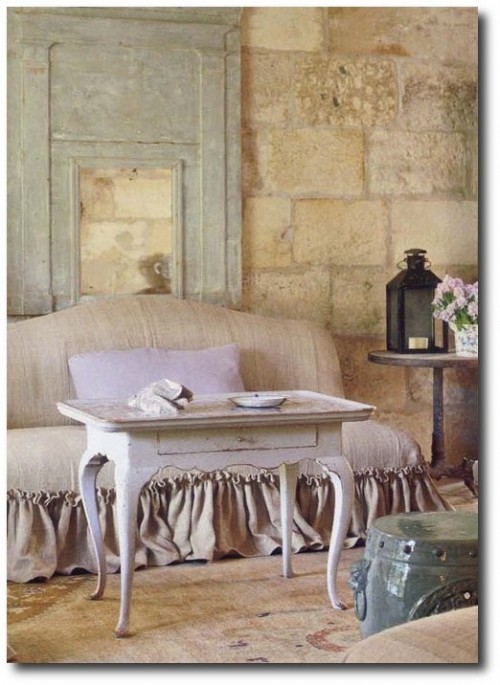
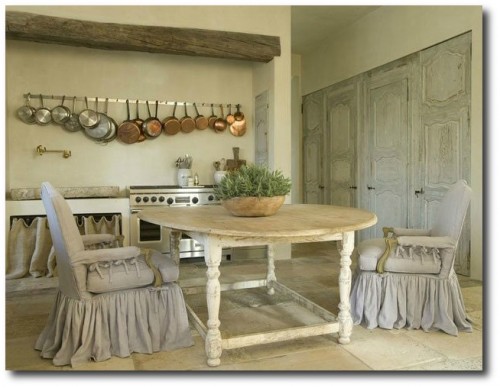
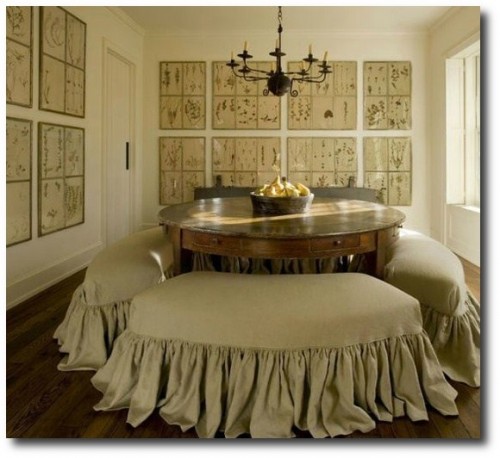
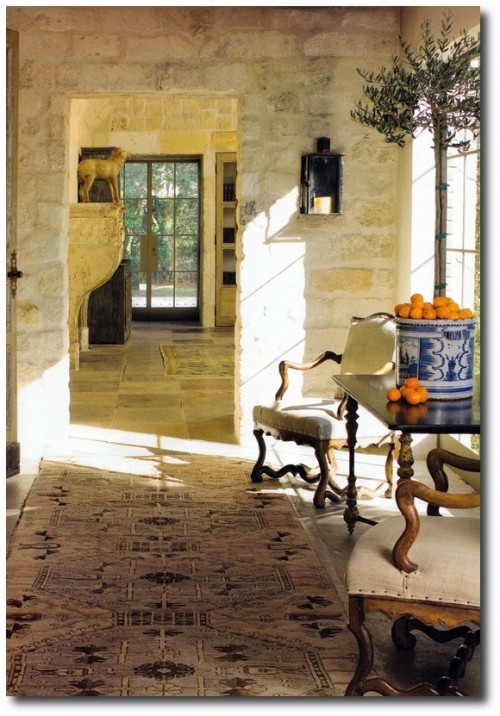
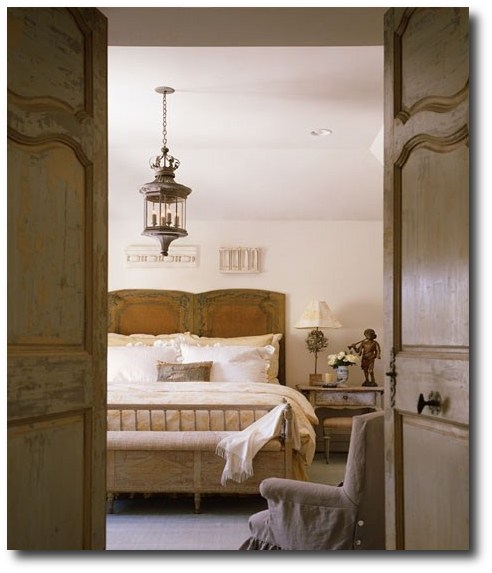
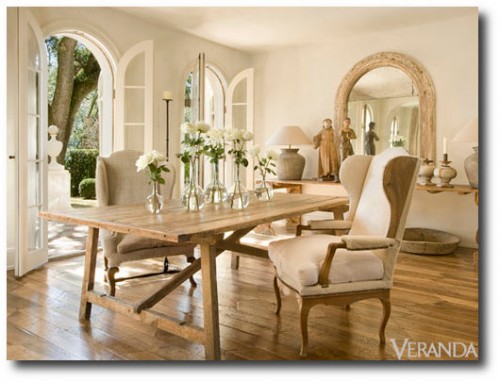
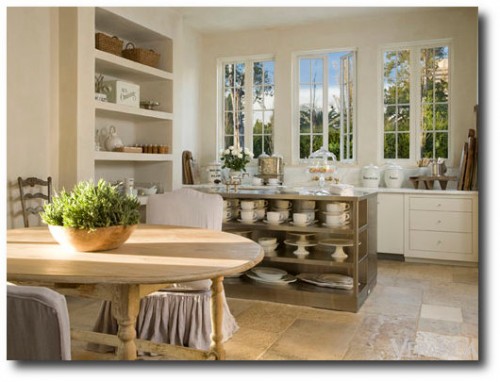
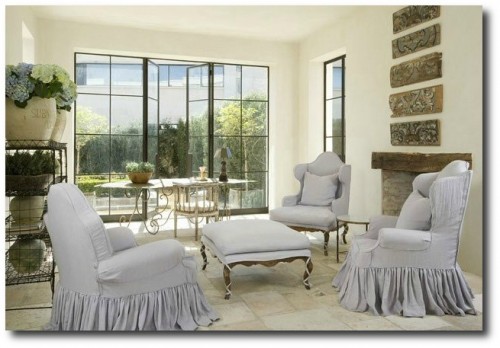
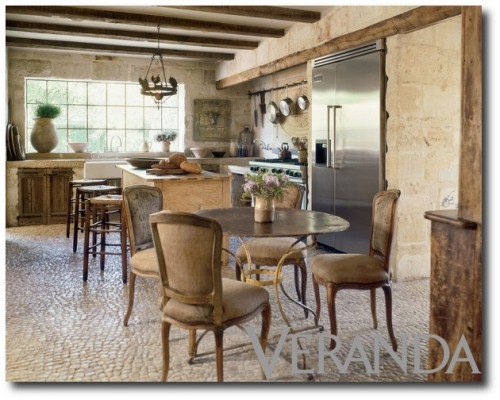
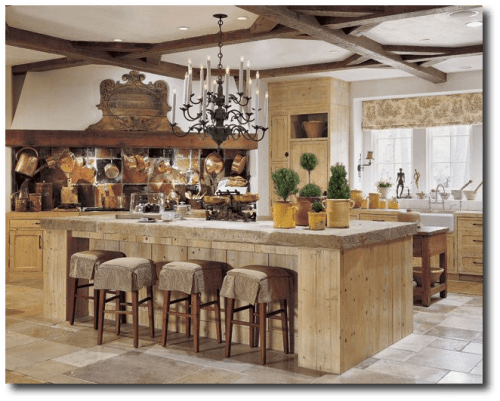
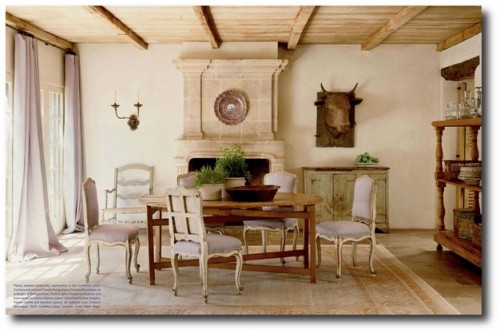
Pam Pierce has single-handedly brought back the popularity of slipcovers, as her interiors bring forth the charm of the old world European interiors to center stage once again. Slipcovers have always played a key role in her interior designs. Linen ruffles and gatherings in dark olive, and oatmeal are paired with stone floors, re-claimed wood tables, white washed wood furniture, and time aged painted decor. Pierce tends to use natural materials like stucco, limestone, reclaimed beams, and sea-grass to create a sense of warmth and history. Her designs also incorporate architectural salvage such as reclaimed antique doors, and iron to create an aged European feel.
Decorators and homeowners have realized the possibilities that slipcovers offer a home. Slip-covers are not only decorative, but practical. At one time, slipcovers served the means of protecting upholstered furniture from the dust of summer months, although they have evolved over the years, from just large sheets which covered furniture, to be tailored to fit the shape of sofas and chairs, even having decorative pleating, ruffles and embroidery.
3 Ways To Borrow Pam Pierce’s Slipcover Looks:
1. Use The Same Material On All Of Your Furniture
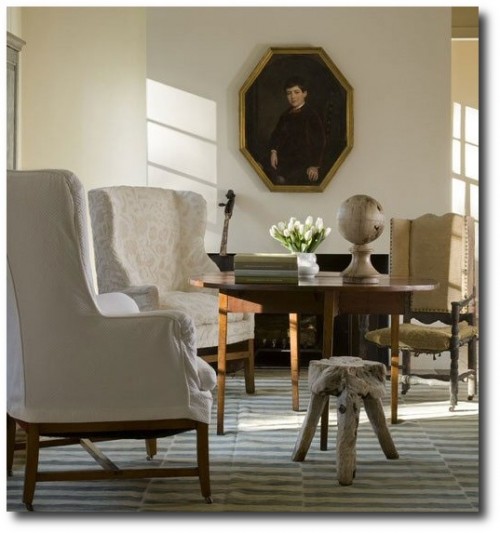
Get the look of a set for less, by slip-covering all of your furniture in the room with the same material. Unite several pieces of furniture out of the same bolt of material. Buying matching sets of vintage or antique furniture can be rare and costly. Create the look of a set by using the same material on all the pieces. Create drapery out of the same material to unite the room. Several ebay sellers offer bolts of fabric, which can be shipped to your home without having to drive from store to store.
2. Choose Natural Fabrics
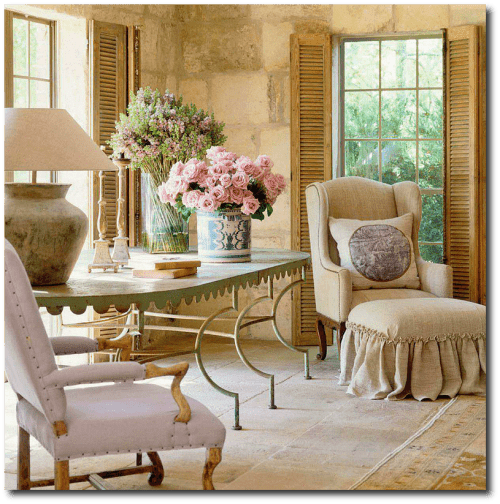
Heavy linen, and cotton canvas have been popular as natural slipcover choices. French tickings can give a natural look, while at the same time, isn’t plain to look at. Consider using unbleached muslin, which can be dyed in soft shades of blue, green, or yellow. Gingham, simple checks and stripes lend a sophisticated touch to a Provence styled home. Stripes, patterns, florals hide dirt well, and are easier to launder. Checks, stripes and florals work hand in hand. Consider using 2 or three fabrics together in a room to create interest.
3. Go The Extra Mile With Detailed Slipcovers
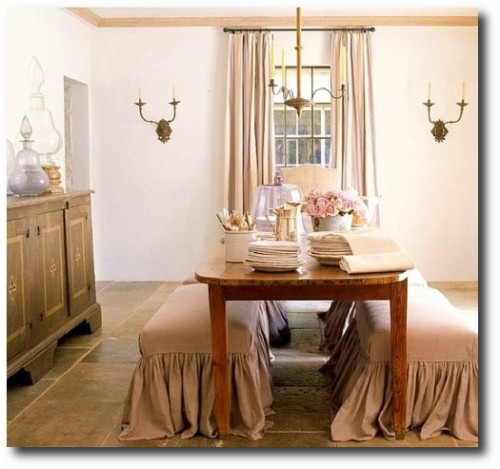
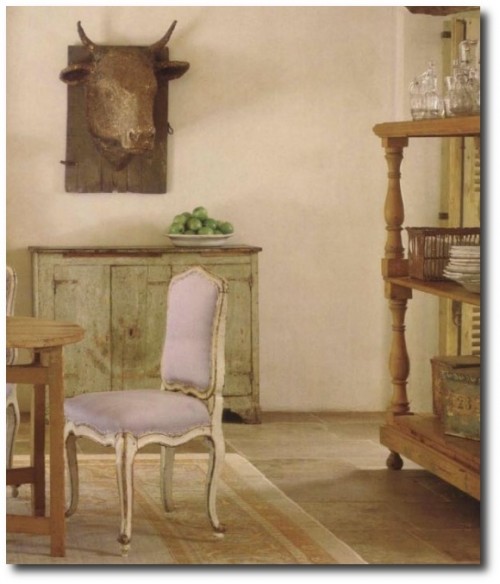
Gathers, and wide flat box-pleats add interest to the bottom of slipcovers. These details can be used just below the seat of the chair, on a line with the seat frame. This style works particularly well with French chairs, as the legs themselves are decorative in themselves that they do not need to be concealed. Consider pairing down the accessories and furniture in your room, and opt for longer gathers, which puddle on the floor. Work this idea in larger rooms, where the furniture itself is the main focal point.
Additional Links:
– Drop Cloth Slip Cover Tutorial-beneathmyheart.net
-How To Make A Club Chair Slipcover- lisaroy.ca
-DIY Ottoman Slip Cover-dittledattle.blogspot.com
-How To Sew Double Cord Welting –littlegreennotebook.blogspot.com
-Upholstery Adhesive – Beacon Magna-Tac 809 –littlegreennotebook.blogspot.com
-How to Make a Sofa Slipcover- makethingsforhome.blogspot.com
-How To Bleach Drop Cloth- myjoyinthejourney.blogspot.com
-Slip Cover Tutorial – 6 Part Video Series- missmustardseed.com
-How To Make A Chair Slipcover- honeybearlane.com
-Wing Back Slipcover- thebrickpathstudio.blogspot.com

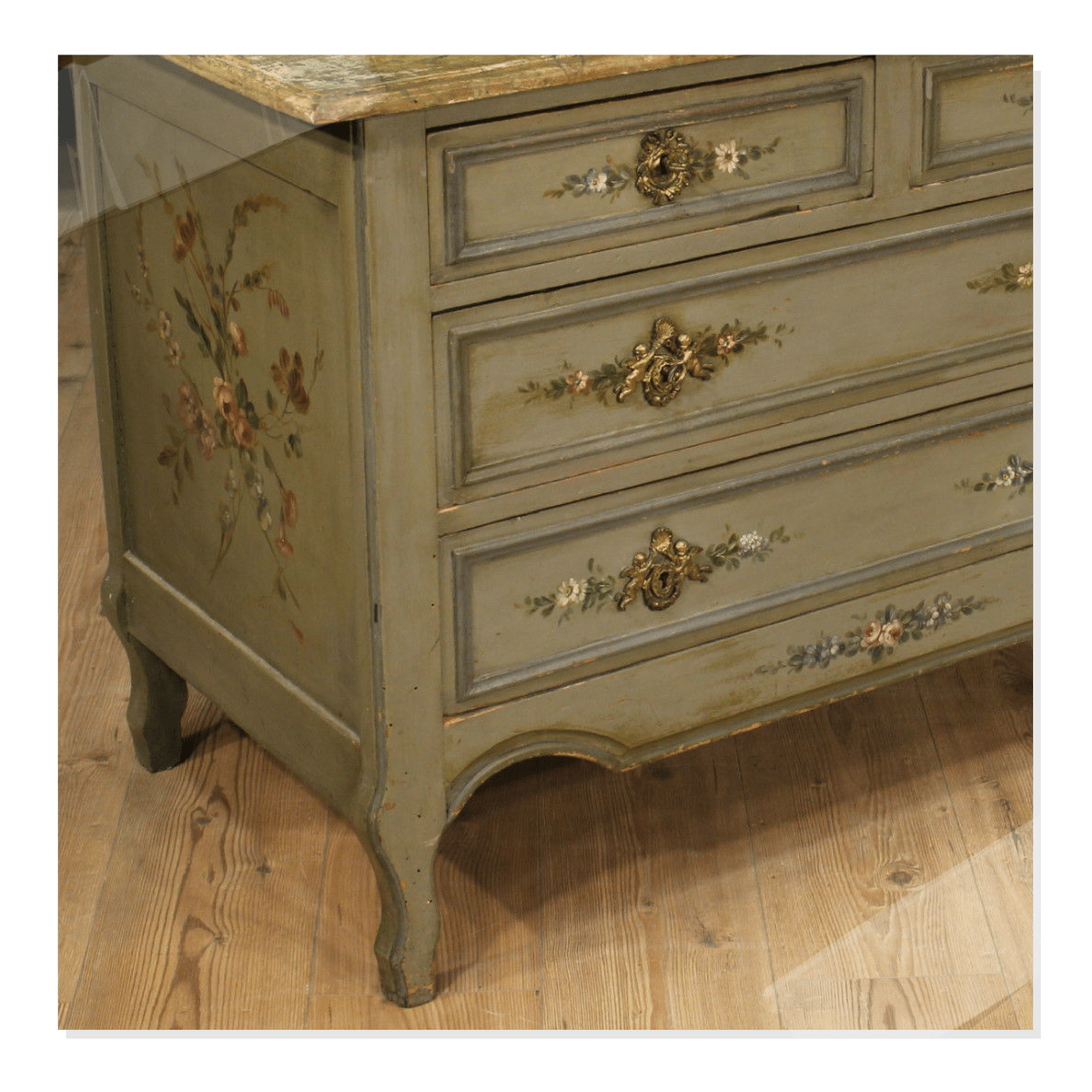
Improve Your French Dresser Or Sideboard With Faux Marble
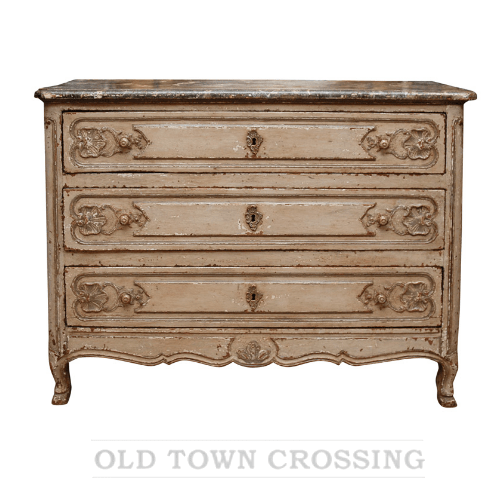 Faux Marble Painted Chest From Old Town Crossing
Marble painting has been an art form since the sixteenth century, and was quite popular in India. In Rajasthan there are around 4000 marble mines and because marble was so widely available, it became a canvas for the local painters. The intricate designs were captured on stone with paint, and sealed to preserve it’s extravagant beauty.
Marble has always been considered a luxury, and can be more expensive in the areas of the world where it isn’t naturally located. The look of marble is the result of interlocking mosaic of carbonate crystals. The swirls and veins form patterns as a result of the mineral impurities such as clay, silt, sand, iron oxides that are present in the layers of the stone. Pakistan is one of the largest marble exporters of the world with exports totaling to around a 100,000 tonnes.
The textured look of marble can add a regal and sophisticated touch to any interior space or piece of furniture, however the trouble is, marble can also grab a chunk of change out of your wallet. Faux marbling is the practice of copying the look of marble with paint. You can improve the tops of your chests, dressers, sideboards and buffets with faux marble.
Faux stone painting was known to be an art used in Pompeii, but it really took off during the Renaissance in Europe where two schools taught the art of faux painting. For professional artists during this time, it took an apprentice 10 years or more to fully master the art. Many of these techniques were used widely by the 17th century and remained useful in architecture well into the 20th century.
Preparations
Start by identifying the style of marble you want to replicate. Marble comes in varied hues of white, pink, gray and black. Go on to the internet and look through the various pictures and decide what look of marble you want to transfer.
Step 1- Sand down the top of your chest or dresser, then paint it with a satin paint. Satin paint will allow all your other paint layers to be able to move around easier. Flat paints will only eat up your paint, and cause them to smear. Start with eggshell.
There are a number of ways to paint marble. Here are a few ways to start as a beginner:
-One very easy way of getting detail and depth without over thinking things is to use plastic. Take a garbage bag, and cut it a little larger than the size of your dresser or chest top. Second paint the plastic, and crumple it slightly before you press the plastic on to the surface. With your hands or a kitchen dough roller, press the plastic into the paint. Next, pull the plastic off, and let the paint dry. When the paint is about dry, smooth out the pattern using an over-sized badger softening brush.This technique works quite well if your paint isn’t thick, but rather thinner. Ideally, you want to build up several layers of detail. I have found using wood stains, which are tinted and transparent, you can get the depth that is seen in marble.
-Another easy technique is creating marble patterns with a sponge. Take the sponge and dab it lightly along the surface to produce a “marble-like” pattern. Take paint and glaze and combine a mixture of 60% transparent glaze to 40% paint. This will enable your pattern to look a bit more organic in nature.
-In the past I have created marble “veins” using a feather, or a paint brush which you can alter, by notching out some of the hair to create a a three prong comb. The smaller paint brushes are usually the best. Drag all your lines diagonally using a twisting and turning motion. Soften the marble lines as the paint is near dry.
The key to faux marble is lots of softening, and transparent layers. You don’t want your marble to appear like it is a two step process, but rather marble that is deep, and takes on the appearance of rich marble. A couple prominent veins really go a long way, amongst softer features.
When you are ready to “seal” in the marble look, use poly-crylic clear gloss or satin. Apply it with a sponge applicator, and let it dry overnight. Then, using 320-grit sandpaper, lightly buff the surface before sweeping off the dust and apply a final coat with a spray can. You can buy polycrylic both in a can and in a spray. The final coat creates a stroke free finish when sprayed. You may want to repeat this process once after the second coat dries.
Using paint to portray a marble finish isn’t as difficult as you might think. Don’t over think the finish, and you will love how it turns out.

Faux Marble by Pierre Lefumat- $28 Amazon
This is a monument to 60 years dedicated to decorative painting. The first part of the book is a step-by-step guide for painting the most widely imitated marble varieties including white breccia, yellow sienna, sea green, and more. The second part of the book is a gallery of Lefumat’s photorealistic faux marble. Each page represents a closer and closer detailed view. Experts and beginners alike will draw inspiration from this magnificent book
Step by step instruction for recreating Lefumat’s masterworks in Faux Marble. Over 140 pages of rich close-up color photographs of Lefumat’s painted panels. Hundreds of pages of faux marble for reference and inspiration.

French Painted Enfilade With Faux Marble Top- Foxglove Antiques
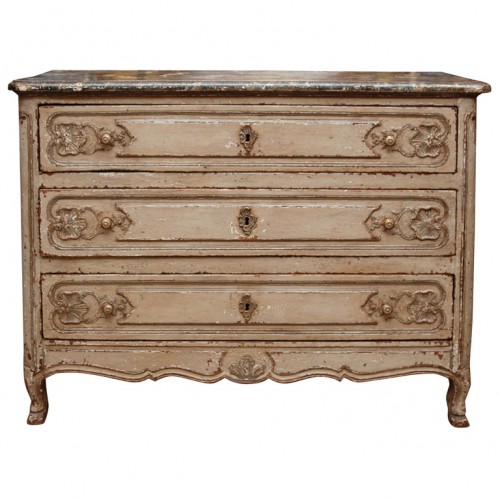
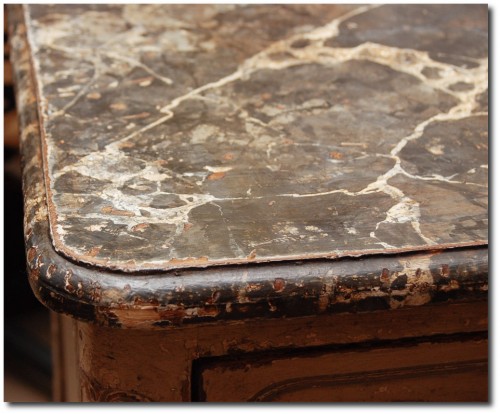
Faux Marble Painted Chest From Old Town Crossing

French Painted Enfilade With Faux Marble Top- Foxglove Antiques
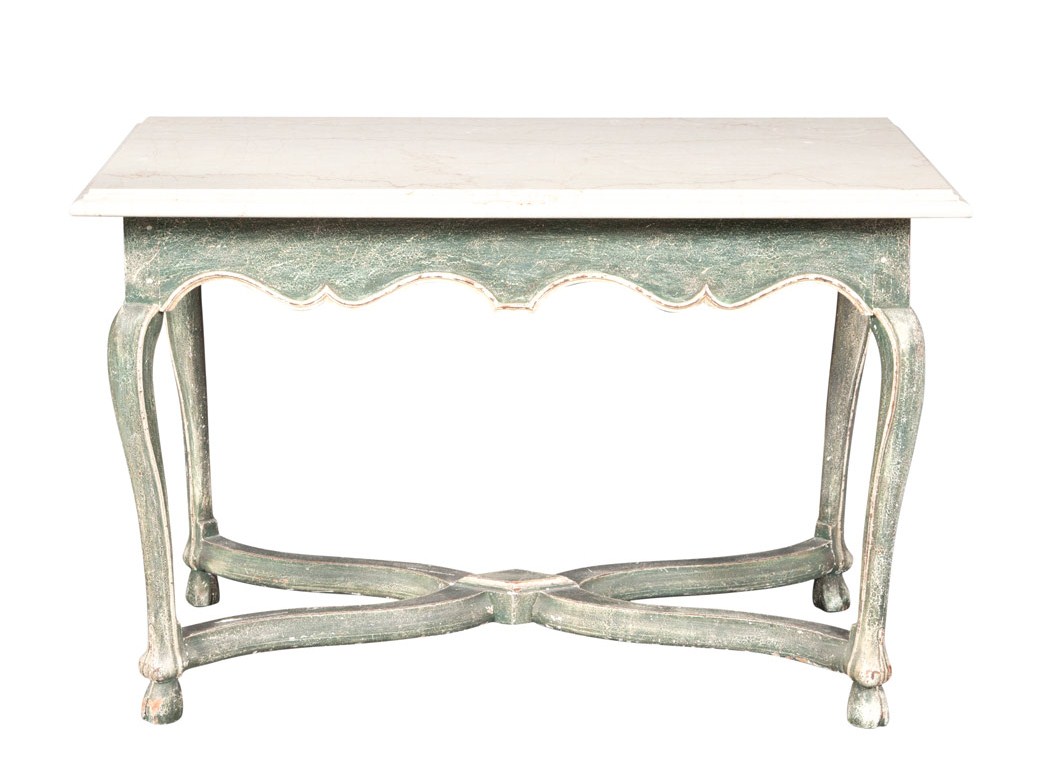
Provincial Style Marble Top Painted Side Table Doyle Auction

Faux Marble Writing Desk- Hideaway Antiques
Swedish Giltwood And Cream Painted Table With Faux Marble Top- Christies

Pair White Granite Urns on Faux Marble Pedestals- Gottlieb Gallery
Italian Neoclassic Faux Marble Scagliola Pedestal- David Neligan Antiques
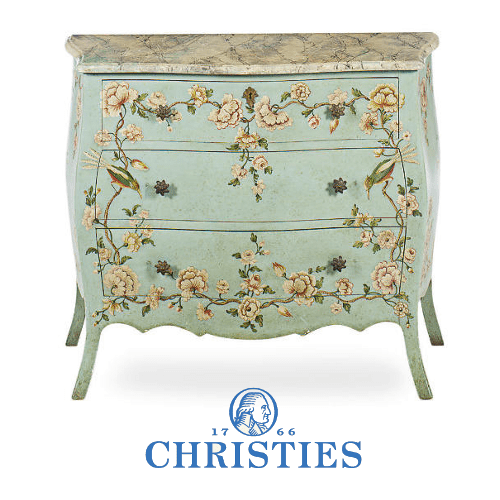
A Painted Faux Marble Serpentine Bombe Commode From Christies

Italian Painted Console Table- Piet Jonker Architectural Antiques

A Pair Of Painted Wooden Night Stands- Piet Jonker Architectural Antiques

A Pair Of Painted Wooden Night Stands- Piet Jonker Architectural Antiques

Set of Four 18th Century Faux Marble Columns 1st Dibs Paris

Louis XV Painted Console Table With A Faux Marble Top- Wirthmore Antiques

Pair of Faux Marble Painted Columns- LEBRETON INTERIEURS

Modern Louis XVI Style Giltwood Table Painted Faux Marble Top- Seller Glo

A Florentine Gilded Console With Faux Marble Top- Valobra Jewelry & Antiques

Pair Faux Marble Columns- Greenwich Living Antiques & Design Center
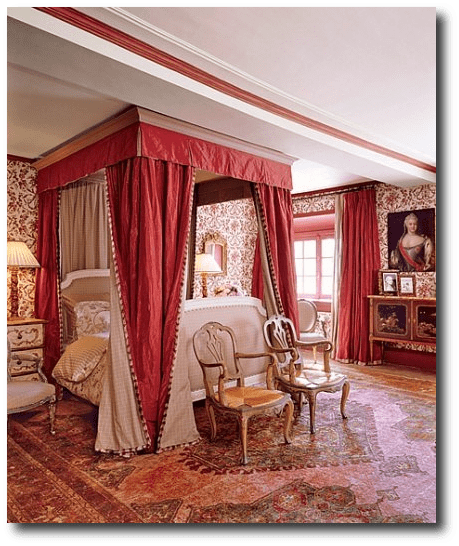 Located 30 miles south of Paris and widely considered one of the most spectacular examples of 18th-century style, the Château du Marais is home to the apartment of designer Juan Pablo Molyneux and his wife, Pilar. The castle was built by the architect Jean-Benoît-Vincent Barré for Master Jean de La Martinière, Treasurer General of Artillery and Engineering, and has been considered one of the most remarkable examples of castle style Louis XVI located near Paris. This castle has been owned by families like Noailles, Castellane, Talleyrand-Perigord and Pourtales.
Additional Links:
New York Social Diary– The Hotel Claude Passart, the 17th century Paris residence of Mr. and Mrs. Juan Pablo Molyneux.
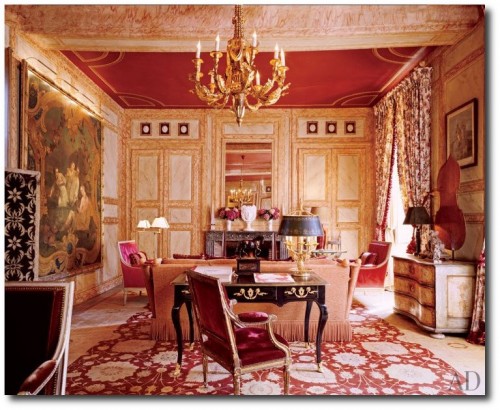
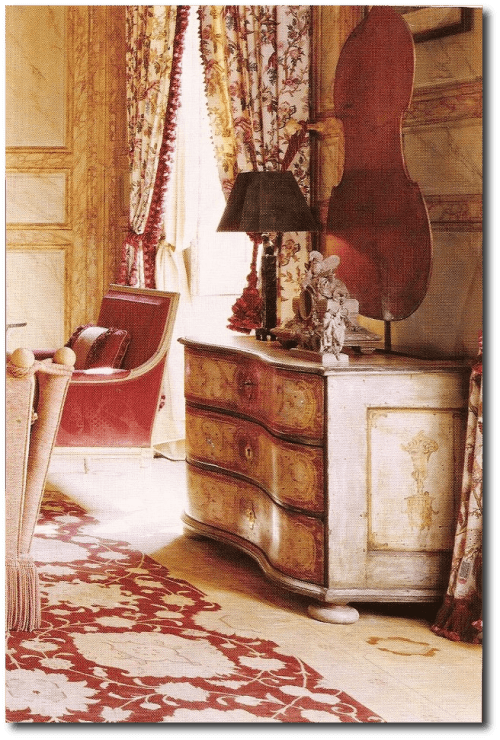
Designer Juan Pablo Molyneux refurbished the 17th-century structure at Château du Marais with rich tones to suit his grand style. An 18th-century gilt-wood chandelier hangs above a Régence bureau plat, a Louis XVI armchair, and a rug from the 19th century; the oil painting is from the 18th century. (Photo Credits- Architectural Digest September 2006)
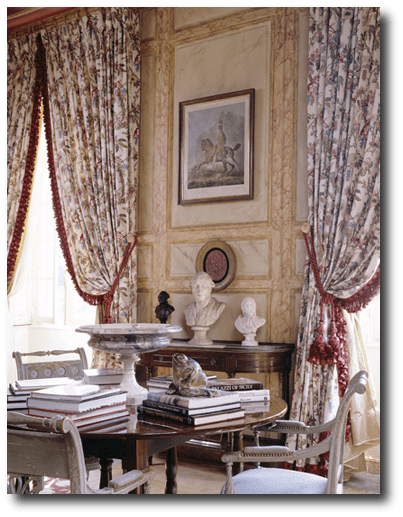
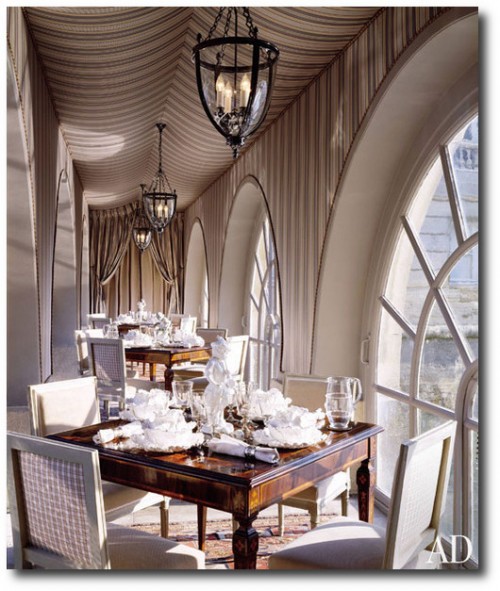
Check out the beautiful marble walls
A Pair Of Painted Wooden Night Stands- Piet Jonker Architectural Antiques

19th Century Italian Carved Wood Bust On Faux Marble Base. Thomas Jolly Antiques

20th c. French Faux- Marble Column or Pedestal- Olivier Fleury Inc.

Pair of Italian Faux Marble Planters- Dragonette Ltd

Frederic Mechiehe’s Provence Home In Hyeres
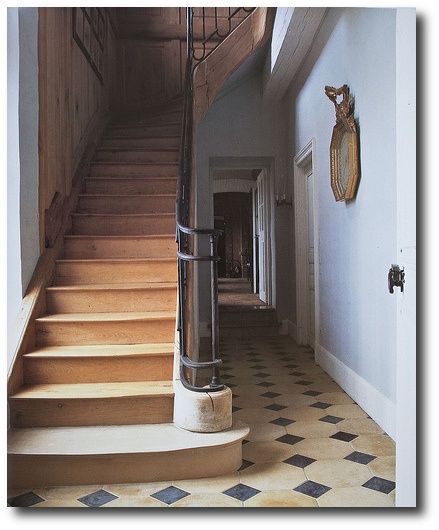 When Frederic Mechiehe arrived at this chateau in Normandy, he was faced with decaying floors and a missing roof. Everything in this home had to be reassembled or “faked”. Period style wooden stairs were installed and artificially worn and hollowed by an industrial sanding machine. The stone floor with black marble lozenges were also added. In this picture, the only thing genuinely to be period is the Louis XVI barometer on the wall. Taken From-Rooms To Remember – Interiors Inspired by the Past By Barbara Stoeltie.
Interior designer, Frederic Mechiche is known quite well in France for re-creating the old world interiors that many of us dream about. So it comes at no surprise that his own home would be fulled with beautiful French antiques, and breathtaking detail. His home is located in Hyeres, which is the Provence-Alpes-Côte d’Azur region in southeastern France. Hyères is the oldest resort on the French Riviera. His home, a fourteenth-century fisherman’s cottage which has retained much of it’s architectural elements The details which are preserved give the home warmth and depth, and a sense of story behind the charming details. The irregular walls, original plasterwork and ancient floors have all remained true to their original form and provide some interest.
Avant-Gardenist on Flicker features the chapter that covers Frederic Mechiche in the book Rooms To Remember – Interiors Inspired by the Past By Barbara Stoeltie. Here are few excerpts from the book:
“Whatever the reason, the desire for the patina of a bygone era is very powerful. Frederic Mechichc, one of France’s most prominent designers, has busied himself in his old fisherman’s house in the south of France in an attempt to “deceive the eye”, furiously attacking his walls with a hammer and having them re-stuccoed as many times as necessary to achieve an age-worn surface.Mechiche has proved over the years that he is a master of the most complicated means of achieving an illusion of age. He has stained his walls with pigment, milk, and coffee, ground away at the edges of a stone staircase to create the impression ot wear, and applied layers of paint to a wall, only to scrape them off later to obtain a multi-layered that could have been caused by centuries of repainting.”
” A few years ago, however,he managed to overcome his horror of the French Riviera for long enough to visit a friend in the area who claimed to have found a haven of peace. Strolling through the narrow, twisting streets of an ancient town with a Romanesque church, he was suddenly confronted with “a small, tall house, eaten away by time, unusually beautiful, and up for sale.” The estate agents description of “warped” floors and “appalling” condition were enough to whet his appetite. Mechiehe was on the lookout tor things authentic and deeply suspicious ot terms like “luxury,” “frilly restored,”and “impeccable,” saying “I’d rather contemplate a door and a few windows with their paint peeling off!” Where the patina of centuries did not exist, Frederic Mechiche invented it. First of all, he astonished the whole neighborhood by climbing up a ladder and plastering…… the entire surface of his facade with an ocher paste,daubing it with evil-smelling mud, and drenching the result with hundreds of gallons of greasy, opaque water to recreate the effect of age. Then a team of masons,
carpenters, and painters came and went for six months, and Mechiehe spent weeks going around the demolition yards of the region, tracking down eighteenth-century architectural salvage”
If you like the pictures featured in Rooms To Remember – Interiors Inspired by the Past consider buying the book….
More About Rooms To Remember:
The Stoelties, regular contributors to World of Interiors magazine, depict European and American interiors that use the period of their historic buildings to inspire their interiors. Rather than authentic re-creations of period decorating, these interiors have been designed to combine contemporary decorating styles with historic furniture and decorative accessories”
Barbara Stoeltie has been a regular contributor to The World of Interiors since 1984 and regularly collaborates with her husband Rene’ on magazine articles.Rene’ Stoeltie’s own interiors have been featured in Decoration Internationale, and his photographic work has appeared in magazines all over the world, including The World of Interiors, House and Garden, Elle, Country Homes and Interiors, Harper’s Bazaar, Colonial Homes, and Classic Homes.
Timeless Interiors: Rooms Inspired by the Past by Barbara Stoeltie and Rene Stoeltie– Timeless Interiors is about capturing the romance of the past without throwing away your washing machine and living in an old fashioned way. Primarily an inspirational source book, it shows how to recreate the tricks designers use: she shows why a room looks romantic and how to get that effect through colors, paint, wallpaper, flower arrangements or still-lives on a shelf. The opening chapter of the book is a detailed story of the featured houses. The following sections are divided room by room: halls, sitting rooms, studies, bathrooms, bedrooms, kitchens and dining rooms.
Picture Credits
Picture Credits are due to Sotto Il Monte Vineyards Blog, whom scanned in all these beautiful pictures below. The original source is – Mediterranean Living By Lisa Lovatt-Smith
Other Beautiful Posts By Sotte Il Monte Vineyards Blog
– Christian Tortu – Design Inspiration – Christian Tortu is one of the leading floral designers in France
– Charleston Interior Designer Amelia Handegan’s summer house at Folly Beach
Additional Links:
– French Style Authority Blog– French Decorator Frédéric Méchiche
– Elle Decor -In a former office building, French decorator Frédéric Méchiche re-creates 18th-century grandeur for a couple who also love contemporary art.
– Trouvais Blog– An 18th century Venetian églomisé mirror are from Frédéric Méchiche’s Paris apartment in the January 1994 issue of World of Interiors photographed by René Stoeltie.
–Door Sixteen Blog– Interior designer Frédéric Méchiche‘s 1712 home in le Marais, which he calls “a tribute to Bauhaus in Paris”.
–My Best Interior Design Ideas– Interior Designer Frederic Mechiche’s apartment in Paris
–Interior Archive– Interior designer Frederic Mechiche’s Parisien home was once 3 separate apartments that he has reorganized to form one light, harmonious apartment on two floors with the guiding idea of creating something of the feel of a small Directoire townhouse. Remodelled with salvaged wooden panelling, period stone floors, cornicing and mouldings the space has the laid back organic feel
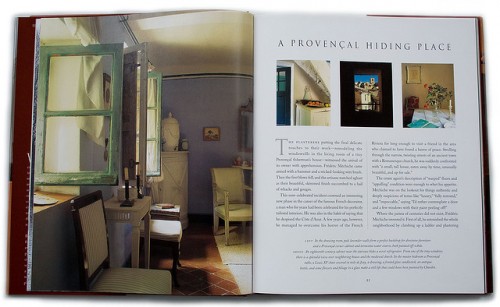 Frederic Mechiche in the book Rooms To Remember – Interiors Inspired by the Past By Barbara Stoeltie.